
Weak indoor mobile signal is not only a user experience problem. In many homes, offices, shops, warehouses and commercial buildings, poor signal can affect calls, mobile data, payment terminals, business communication and daily operations. The real cause is often simple: outdoor signal becomes weaker after passing through concrete walls, metal structures, glass coating, basements, long corridors or complex indoor layouts.
For these projects, a small consumer booster is often not enough. The system needs higher gain, stable output control, proper antenna isolation and flexible band support. This is where [CB75B 75dB signal booster] becomes a practical choice.
What Is CB75B?
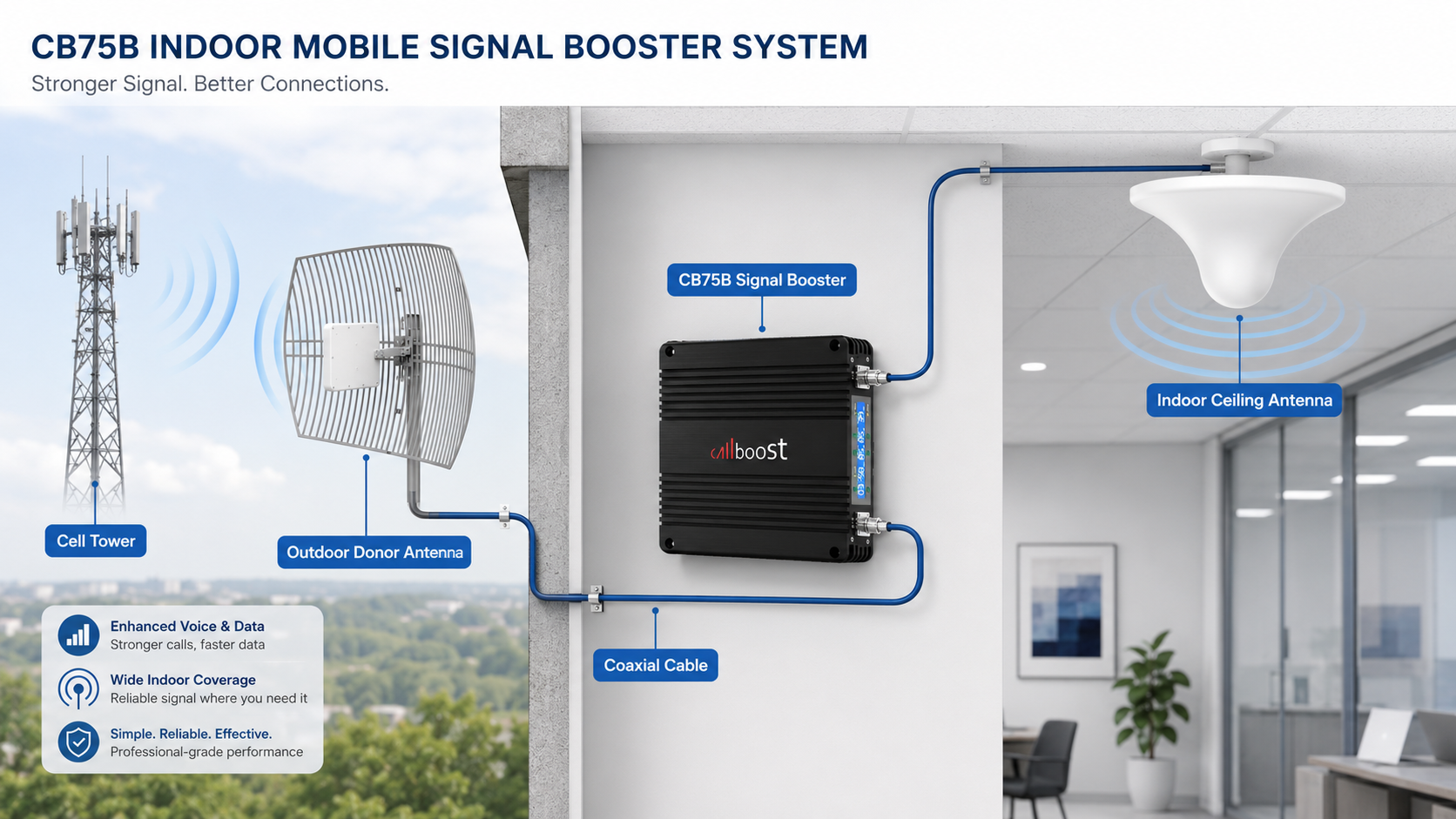
CB75B is a 75dB-class [mobile signal repeater] designed to improve indoor cellular signal coverage. It receives outdoor mobile signal through a donor antenna, amplifies the selected frequency bands, and redistributes the signal indoors through service antennas.
Unlike very small home-use boosters, CB75B is built for more demanding indoor coverage projects. It can be used in residential buildings, offices, stores, small factories, supermarkets, basements and other medium-sized indoor environments where stable mobile communication is required.
The product supports multiple customized band combinations, including common 2G, 3G, 4G and selected 5G frequency options depending on the target market and operator network. This makes it suitable for distributors, installers and project buyers who need one platform for different countries and network environments.
Why 75dB Gain Matters
Gain is one of the key factors in a signal booster system. A higher gain level allows the repeater to compensate for outdoor signal weakness, cable loss and indoor distribution loss.
CB75B provides around 75dB downlink gain and around 70dB uplink gain, making it suitable for indoor projects that need stronger coverage than compact entry-level boosters. In a correctly designed system, this gain level helps deliver more stable signal to indoor areas where phones previously showed weak bars or unstable data connection.
But gain alone is not enough. A booster with high gain but poor control can easily create instability, interference or self-oscillation. That is why CB75B combines gain with automatic control and protection functions.
Key Technical Features of CB75B
CB75B is not just a basic amplifier. It includes several control functions that are important for real indoor deployment.
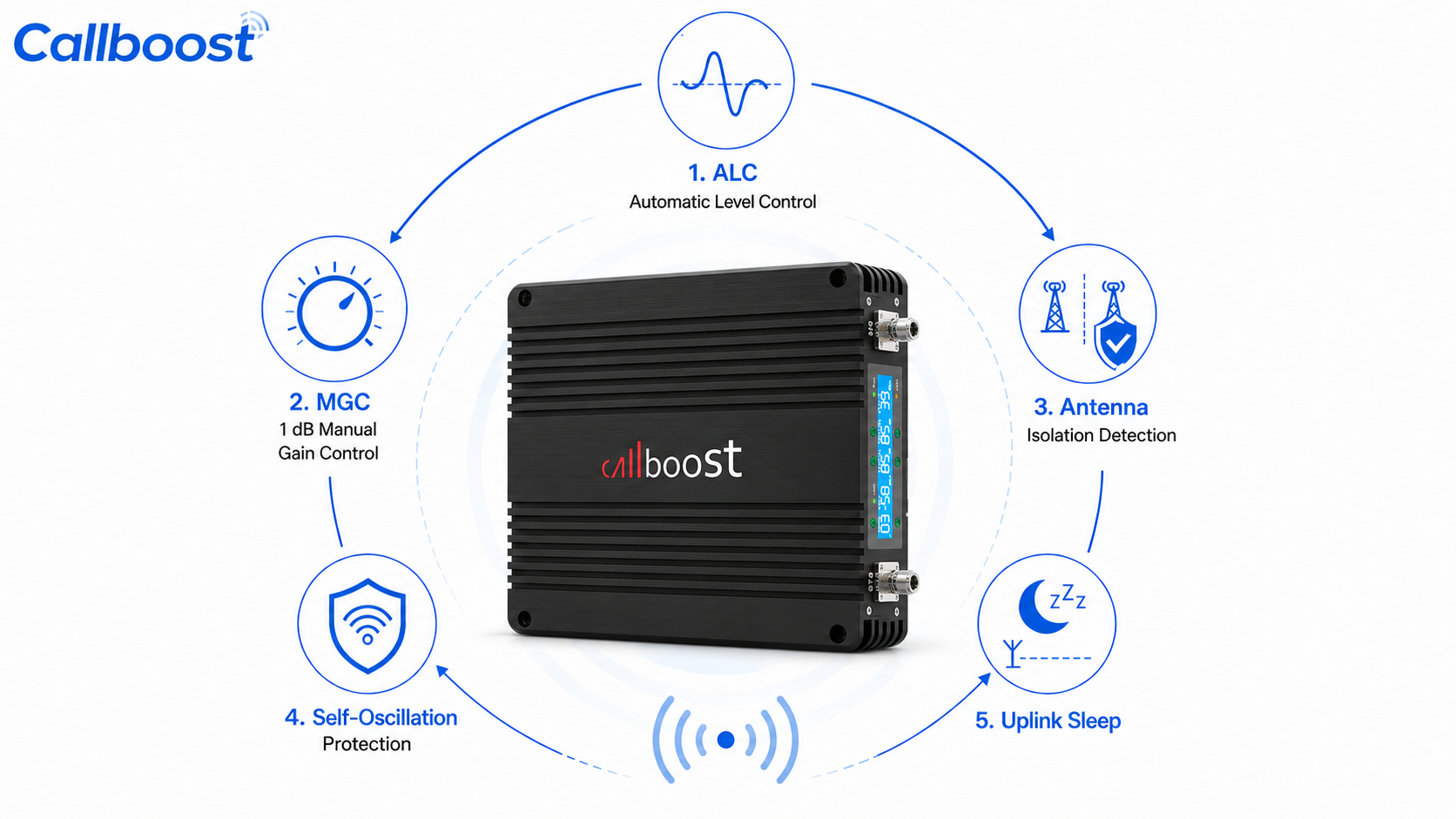
First, the system supports automatic level control. This helps keep output power stable when the outdoor signal changes. In real projects, outdoor signal strength is rarely fixed. It can change due to weather, base station load, user movement or antenna direction. ALC helps prevent unstable output and protects the booster from excessive input signal.
Second, CB75B supports manual gain control with 1dB step adjustment. This is useful for installers because not every building needs maximum gain. In some projects, reducing gain is necessary to balance coverage, avoid overload or improve system stability.
Third, CB75B supports isolation detection and self-oscillation protection. This is critical. If the outdoor donor antenna and indoor service antenna are too close, or if their signal paths leak into each other, the system can oscillate. That can reduce performance or force the booster to shut down. CB75B helps detect this problem and protects the system.
Fourth, the uplink sleep function helps reduce unnecessary uplink transmission when there is no active mobile device using the system. This helps lower interference risk toward the base station and supports more responsible network operation.
Where CB75B Is Suitable
CB75B is suitable for medium-sized indoor coverage projects where the outdoor signal is available but indoor signal becomes weak.
Typical applications include:
Homes with thick walls or poor indoor reception.
Offices where calls drop near inner rooms or meeting areas.
Retail stores where mobile payment terminals need stable connection.
Small warehouses where workers depend on mobile communication.
Basements or semi-underground spaces where signal penetration is weak.
Small commercial buildings that require multi-room indoor distribution.
The important point is this: CB75B does not create signal from nothing. It needs usable outdoor signal from the operator’s base station. If there is no outdoor signal at all, the correct solution may require a different engineering approach, such as a higher-gain donor antenna, different antenna position, or in larger projects, a fiber repeater system.
This is also why proper site checking matters before installation.
Correct System Design Is More Important Than Only Choosing the Booster
Many failed booster projects are not caused by the repeater itself. They are caused by wrong system design.
The most common mistakes include choosing the wrong frequency band, placing outdoor and indoor antennas too close, using long low-quality cable, selecting the wrong indoor antenna type, or using splitters without calculating loss.
A correct CB75B system normally includes an outdoor donor antenna, the CB75B repeater, RF cable, indoor service antennas, and splitters or couplers when multiple indoor antennas are required. The donor antenna should face the strongest and cleanest outdoor signal source. Indoor antennas should be placed according to the building layout, not randomly installed wherever convenient.
For open indoor areas, ceiling antennas are often used to provide more even coverage. For corridors, parking areas or directional coverage zones, panel antennas may be more suitable.
CB75B Product Positioning
CB75B is positioned between compact small-area boosters and high-power engineering repeaters.
For small rooms, apartments or small shops, a lower-power booster may be enough. For large buildings, factories, tunnels, mines or wide-area engineering coverage, higher-power models such as [CB90C high power signal booster] or [CB95C signal booster] may be more suitable.
CB75B is a good fit when the project needs stronger performance than a small booster, but does not require a large 5W or 20W engineering repeater. This makes it practical for distributors and installers who often handle medium-sized indoor coverage projects.
For buyers who are comparing product levels, Callboost also provides compact models such as [CB70B quad band signal booster] and higher-power engineering models for larger coverage requirements.
Main Advantages of CB75B
The first advantage is balanced performance. CB75B provides stronger gain and output than entry-level boosters, while still remaining suitable for indoor building deployment.
The second advantage is flexibility. It can support different band combinations according to country, operator and project requirements.
The third advantage is system stability. ALC, MGC, isolation detection, self-oscillation protection and uplink sleep make the booster more suitable for real installation conditions.
The fourth advantage is engineering usability. Installers can adjust gain, check system status and optimize the layout according to actual signal conditions.
The fifth advantage is product scalability. CB75B can be used with different antennas, splitters, couplers and cable plans, allowing it to serve different building structures instead of being limited to a fixed kit.
Before Choosing CB75B, Confirm These Points
Before selecting CB75B, buyers should confirm the local operator frequency bands. A booster must match the actual network bands used by the mobile operators. Choosing the wrong band is one of the fastest ways to make a booster system fail.
The second point is outdoor signal quality. The donor antenna location should be tested before installation. The best position is not always the highest position; it is the position with the cleanest usable signal and proper direction toward the base station.
The third point is indoor coverage target. A single indoor antenna may be enough for a small area, while multi-room buildings may require multiple antennas and a proper splitter or coupler layout.
The fourth point is cable loss. Long RF cable runs reduce signal strength. The system should use suitable low-loss cable, especially when the donor antenna is far from the repeater or when multiple indoor antennas are used.
The fifth point is antenna isolation. The outdoor antenna and indoor antenna must be separated properly to avoid feedback and self-oscillation.
Conclusion
CB75B is a practical 75dB [cellular signal booster] for indoor mobile coverage projects that need stronger performance, flexible frequency support and stable system control. It is suitable for homes, offices, shops, small warehouses and medium-sized buildings where weak indoor signal affects communication quality.
For buyers, the key is not only selecting the booster. The real result depends on correct band matching, donor antenna placement, cable loss control, antenna isolation and indoor antenna layout. When these factors are handled properly, CB75B can provide a stable and professional indoor signal improvement solution.
For project selection or wholesale requirements, Callboost can provide product matching support, antenna system suggestions and customized frequency band options for different markets.