
What Is CB95C?
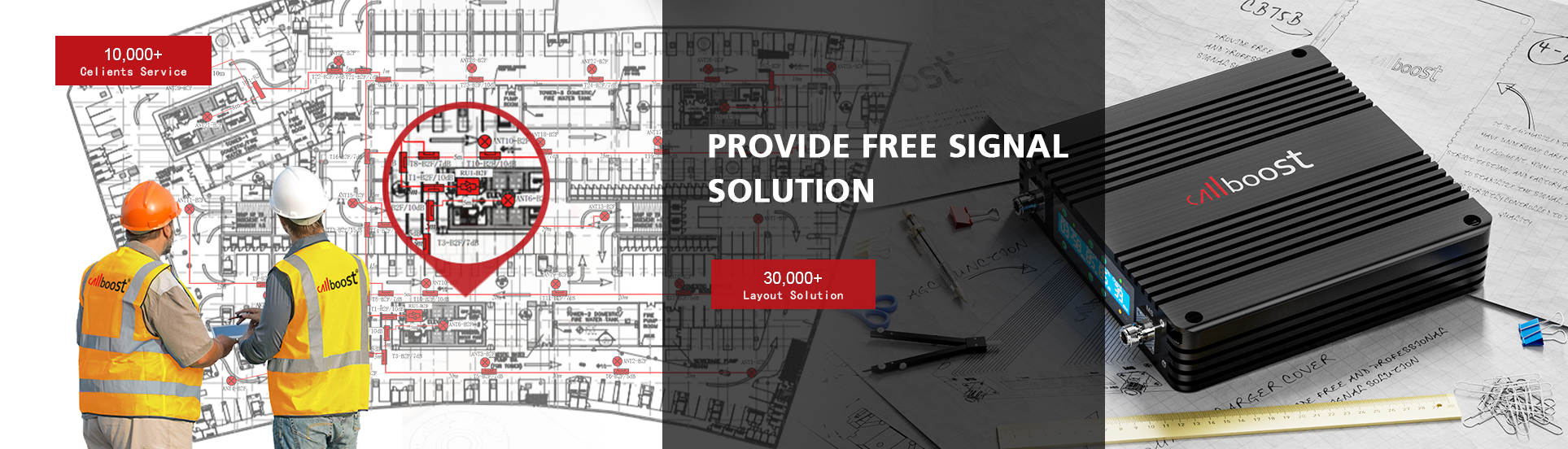
CB95C outdoor signal repeater booster is an engineering-grade mobile signal repeater designed for larger coverage projects where a small plug-and-play booster is not enough.
It is used to receive usable outdoor mobile signal, amplify it through a repeater, and distribute the improved signal to indoor or semi-indoor areas through antennas, splitters, couplers and coaxial cable. For buyers, installers and project contractors, CB95C is not just a single device. It is the core unit of a complete mobile coverage system.
CB95C can be configured for different band combinations depending on the target country, operator network and project requirement. It can support 2G, 3G, 4G and 5G bands depending on the selected frequency version.
Where CB95C Is Usually Used
CB95C is suitable for projects that need stronger signal coverage over a larger area, especially when the building structure, distance from the base station or indoor layout causes weak mobile signal.
Typical applications include:
Factories and industrial buildings
Warehouses and logistics centers
Commercial buildings
Hotels and office buildings
Campuses and residential areas
Parking areas and basement coverage projects
Rural or remote engineering coverage projects
For these scenarios, the main issue is usually not only weak signal. The real problem is system design: outdoor signal source, donor antenna direction, cable loss, indoor antenna layout, power distribution and gain control all affect the final result.
That is why CB95C is more suitable for installers, distributors, telecom contractors and project buyers who need a configurable commercial building signal booster instead of a simple consumer booster.
Key Specifications of CB95C
The CB95C series can be configured for different band combinations depending on the target country, operator network and project requirement.
| Item | CB95C Series Capability |
|---|---|
| Product type | Outdoor mobile signal repeater booster |
| Supported systems | 2G / 3G / 4G / 5G, depending on band configuration |
| Band options | Single band, dual band, triple band and custom band combinations |
| Frequency examples | B1, B2, B3, B5, B7, B8, B28, B38, B40, B41, B66, B78 |
| Downlink output power | Up to 43±2 dBm for single-band version; lower output depending on multi-band configuration |
| Gain | Up to 95±3 dB class, depending on model and band |
| Gain control | Manual gain control and automatic gain control |
| Display | LCD / OLED status display, depending on version |
| Alarm function | Input, output, gain and working status monitoring |
| Connector | N-Female connector |
| Impedance | 50 ohm |
| VSWR | ≤ 2.0 |
| Noise figure | ≤ 6 dB |
| Pass band ripple | ≤ 3 dB |
| Delay | ≤ 1.5 μs |
| Power supply | AC 100–240V, DC 12V / 15A |
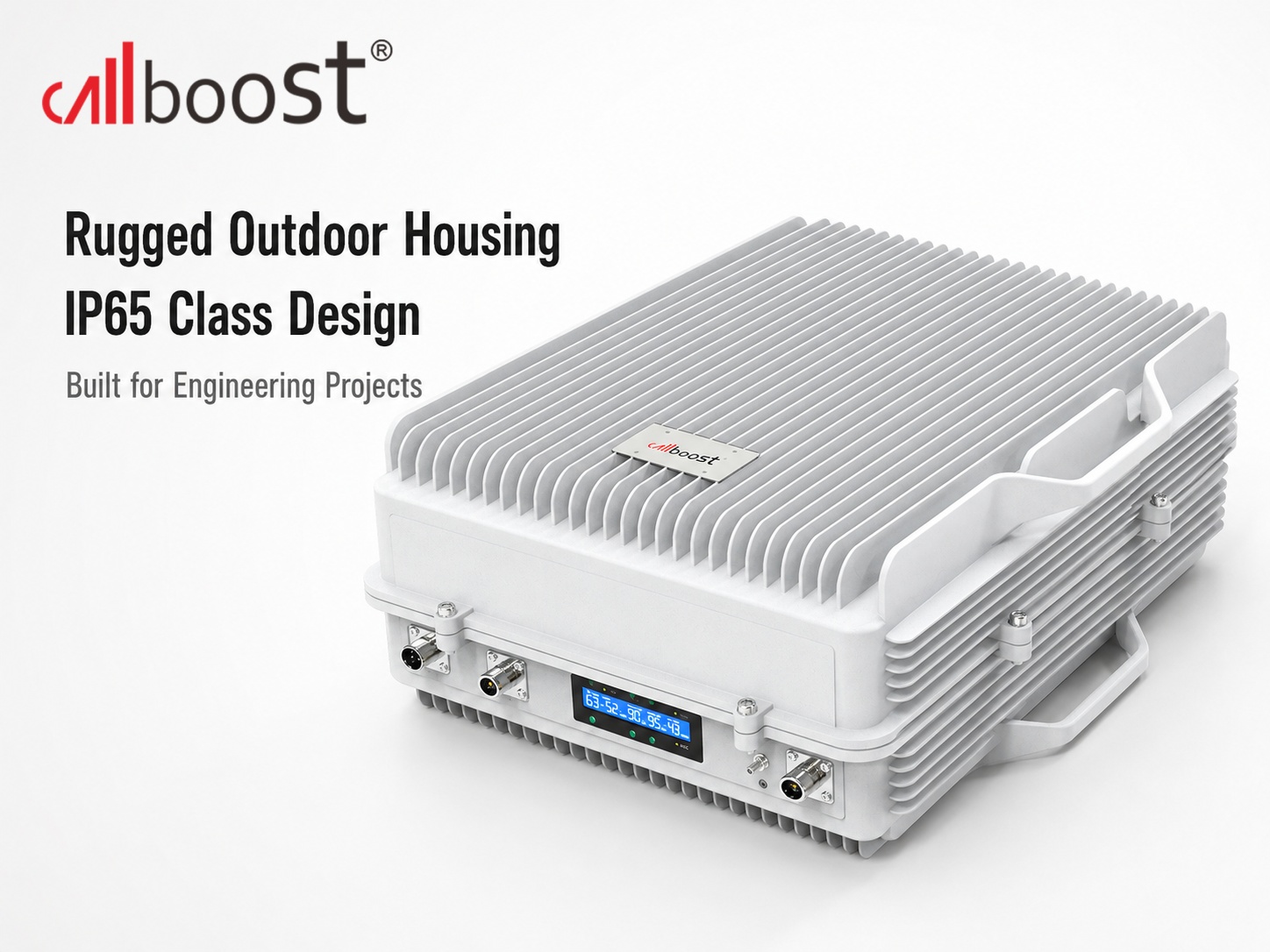
| Protection level | Outdoor-grade housing, IP65 class design |
| Typical coverage reference | Up to around 3000 m², depending on signal source, antenna layout and environment |
| Dimension reference | 520 × 440 × 230 mm |
| Weight reference | Around 35 kg |
| Operating temperature | -10°C to +55°C |
| Storage temperature | -30°C to +80°C |
| Typical use | Factories, warehouses, campuses, commercial buildings, residential areas and engineering projects |
CB95C is suitable for buyers who need more than a basic booster. It is a stronger option for installers, distributors, engineering contractors and project owners who need to build a planned signal coverage system with proper antenna layout and commissioning.
How CB95C Works in a Mobile Signal Booster System
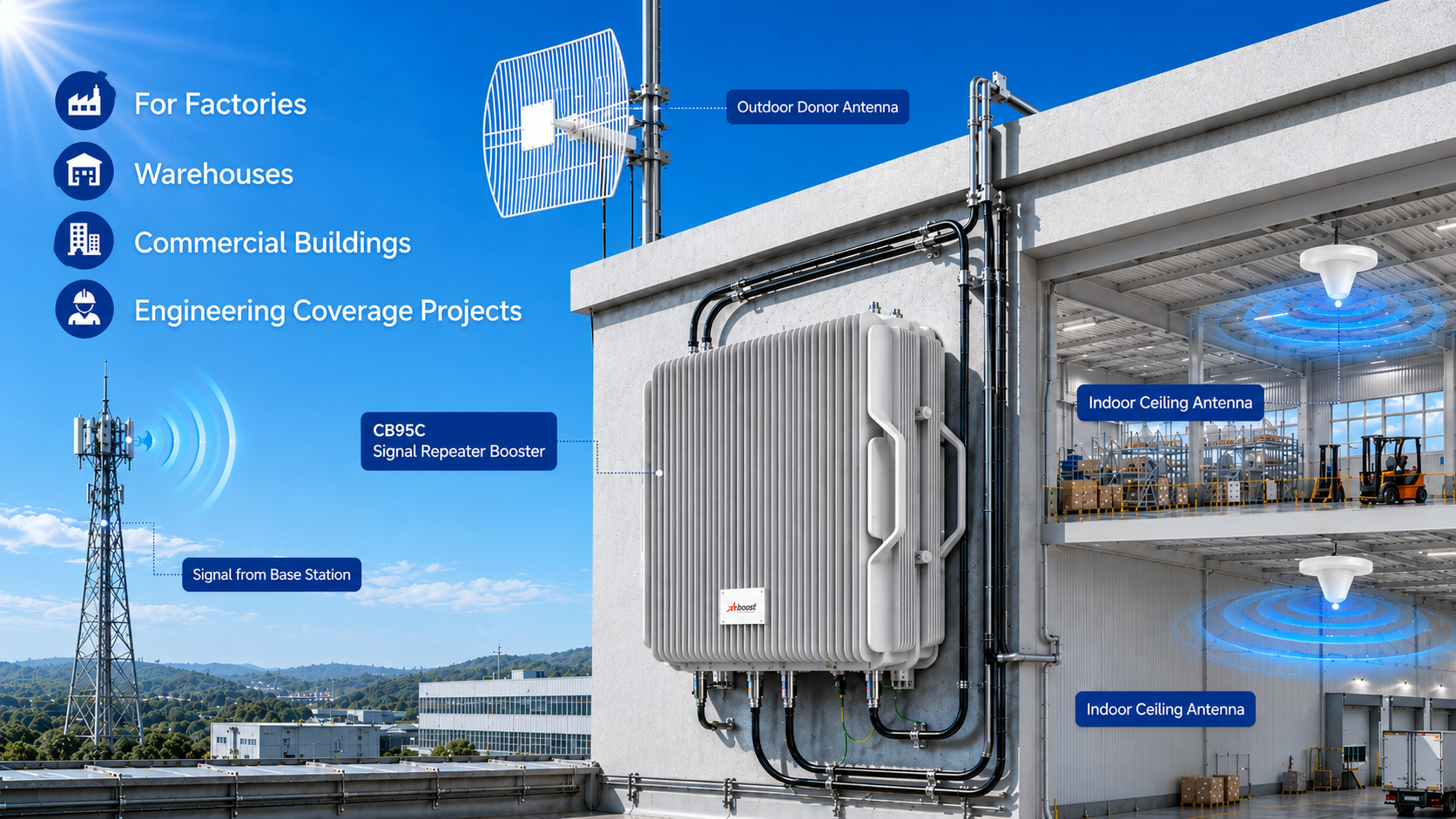
A complete CB95C system usually includes:
Outdoor donor antenna
The outdoor antenna receives signal from the nearest base station. For directional antennas such as a grid antenna, the antenna face must point toward the base station. Wrong antenna direction will reduce system performance.CB95C repeater booster
The repeater amplifies the received uplink and downlink signals. Gain control, AGC and monitoring help installers adjust the system based on the real signal condition.Passive distribution components
Splitters, couplers and coaxial cables distribute the signal to different indoor zones. In larger projects, passive design affects final coverage heavily.Indoor antennas
Ceiling antennas and wall-mounted panel antennas deliver the improved mobile signal to target areas. Ceiling antennas are usually used for open indoor areas, while wall antennas are often used for directional indoor coverage.
This is the part many low-quality articles ignore. A high-power repeater alone does not guarantee good coverage. If the donor signal is unstable, antenna isolation is poor, cable loss is too high or indoor antennas are placed incorrectly, the final coverage will still be weak.
Band Configuration Matters
CB95C is not a one-frequency product. It can be configured for different mobile network bands. This is important because frequency bands vary by country, operator and project type.
Common configuration directions include:
Single-band version for one target operator band
Dual-band version for two major network bands
Triple-band version for wider operator or multi-service coverage
Custom band combinations for project requirements
For example, some projects may focus on common LTE bands such as B1, B3, B7, B8, B28 or B66. Other projects may require 5G-related bands such as B78, depending on local network conditions. The correct choice should be based on local operator frequency, outdoor signal test result and required indoor coverage target.
This is also why buyers should avoid choosing a repeater only by output power. Band match is the first condition. Output power, gain and antenna layout matter after the frequency plan is correct.
Real Project Reference
For buyers who are evaluating project feasibility, real installation experience matters more than generic marketing claims. Callboost has engineering project references such as the Samoa 2T2R fiber optic extension project, which shows how mobile signal coverage can be handled through a planned system instead of a single random device.
Who Should Choose CB95C?
CB95C is suitable for buyers who need a stronger and more configurable solution, especially:
Signal booster distributors
Telecom installation companies
Engineering contractors
Building owners
Factory and warehouse operators
Project buyers who need bulk supply or system support
For small homes or simple shops, a smaller booster may be enough. For large buildings, multi-zone indoor layouts or outdoor engineering coverage, CB95C is a more serious option because it supports higher gain, outdoor-grade housing, configurable bands and system-level deployment.
The buyer should prepare basic project information before selecting the model:
Country and target operator
Required frequency bands
Outdoor signal strength
Building type and coverage area
Indoor antenna quantity
Cable distance
Whether the system needs splitters, couplers or multiple antennas
Without this information, any product recommendation is only guessing.
Recommended Kit Direction
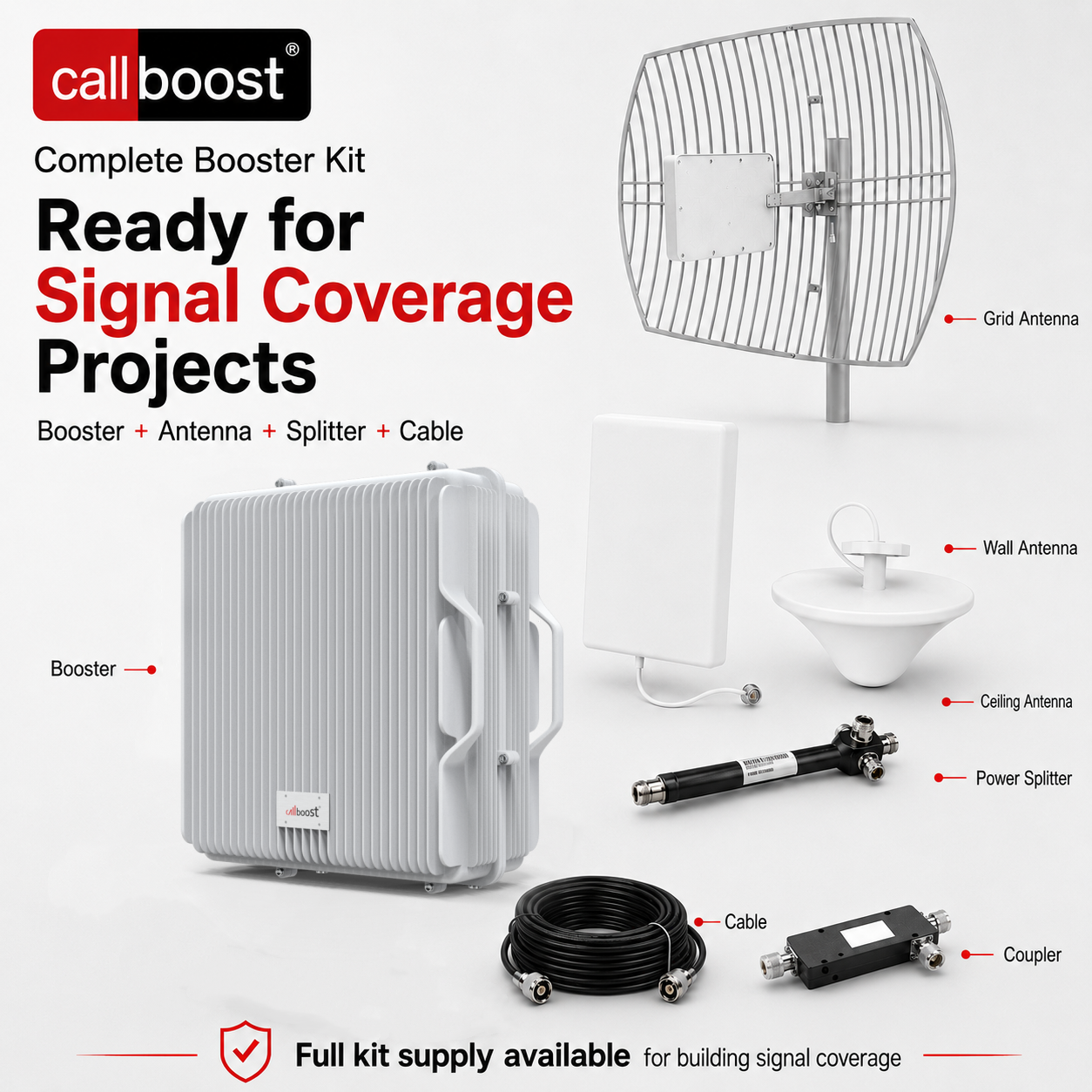
A typical CB95C project kit may include:
CB95C outdoor signal repeater booster
Outdoor donor antenna, such as grid antenna
Indoor ceiling antennas
Indoor wall-mounted panel antennas
Power splitter
Directional coupler
Low-loss coaxial cable
Connectors and installation accessories
The final kit should be selected according to the real building layout. A warehouse, a hotel corridor and a basement parking area should not use the same antenna plan.
Get CB95C Project Support
If you are selecting a CB95C outdoor signal repeater booster for a project, the right model should be chosen based on frequency band, signal source, coverage target and antenna distribution plan.
Callboost can support product selection, band configuration, kit matching and wholesale supply for distributors, installers and engineering buyers.