
Project Background
The project site was a three-story convalescent building used for patient recovery and daily healthcare support. Before installation, the hospital experienced weak indoor GSM signal in patient rooms, corridors, and working areas. Staff reported unstable calls and poor communication quality, especially in enclosed spaces where signal penetration from the outdoor network was limited.
For healthcare environments, weak mobile signal is more than an inconvenience. It can affect daily coordination, internal communication efficiency, and the overall reliability of building operations. In facilities where staff need to move between rooms, floors, and departments, stable indoor coverage becomes an important part of the communication environment.
The project goal was clear: improve indoor GSM signal throughout the building and create a more reliable communication experience for the people using the facility every day.
Pre-Installation Signal Survey
Before designing the system, Callboost engineers carried out a detailed signal survey to understand the real signal conditions inside and outside the building.
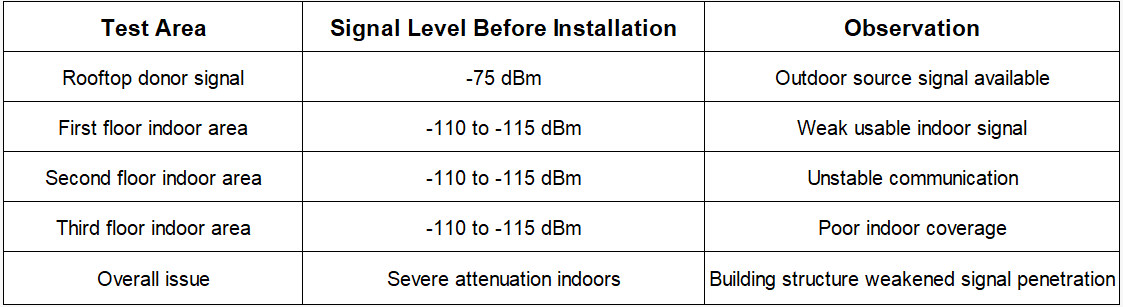
The rooftop donor signal measured approximately -75 dBm, which meant there was an available outdoor GSM source signal that could be captured and used for indoor amplification. However, indoor measurements on all three floors were much weaker, generally ranging from -110 dBm to -115 dBm.
These indoor values showed that the existing signal was not strong enough to support stable communication. In practical terms, users inside the building faced weak signal, unreliable calls, and poor coverage consistency.
The main reason was building attenuation. Concrete walls, floor separation, room layout, and enclosed interior spaces all reduced signal penetration from outside. Although outdoor signal was present, it could not enter and distribute effectively across the entire building. This meant the site required a custom indoor GSM coverage solution rather than a generic signal improvement setup.
Pre-Installation Signal Survey
Custom GSM Indoor Coverage Solution
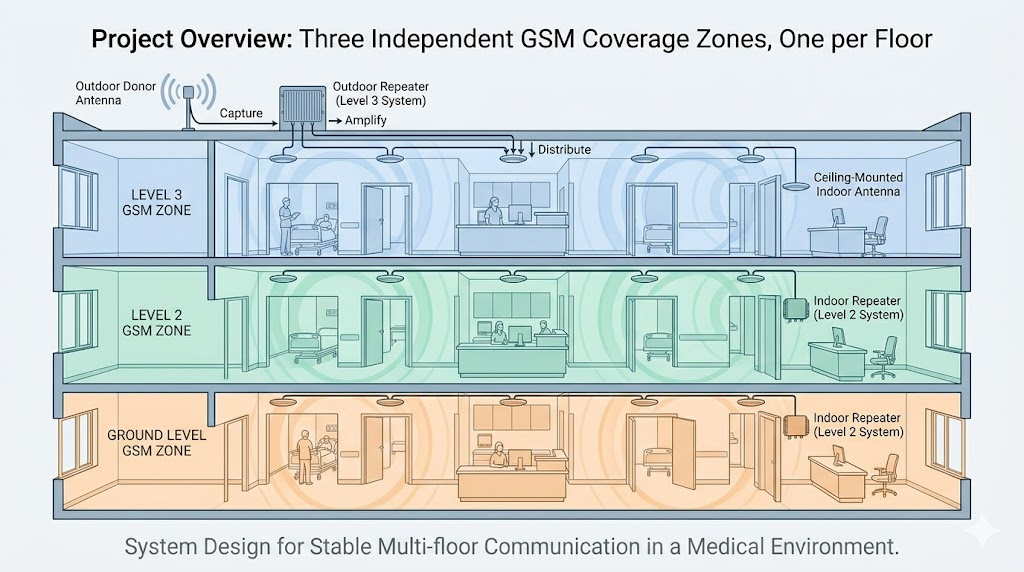
Based on the site survey, Callboost designed a three-zone GSM signal booster system, with one repeater unit assigned to each floor. This floor-by-floor coverage strategy made it possible to distribute the signal more accurately, reduce interference between levels, and match system output to the actual needs of each floor.
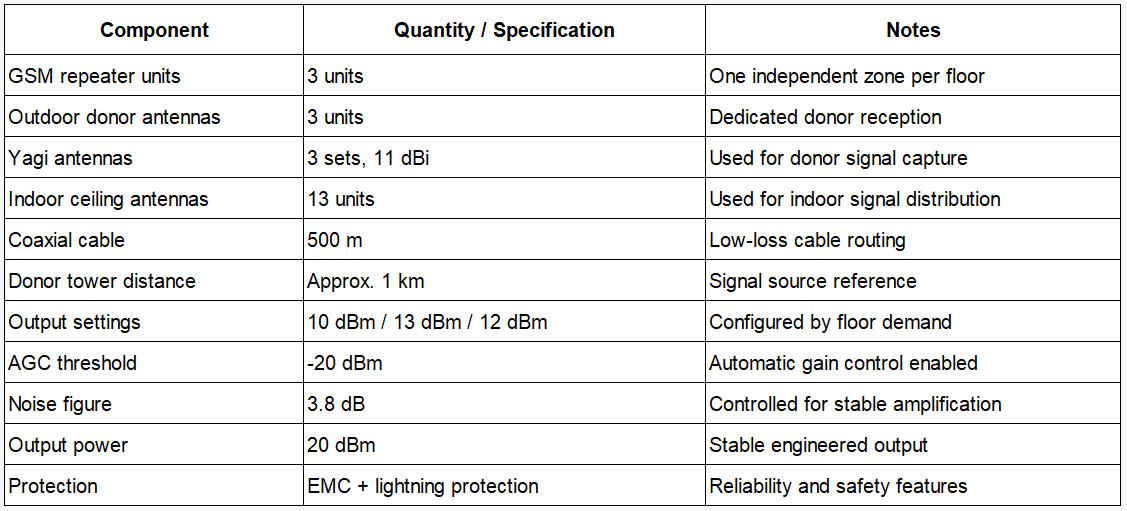
The completed system included:
· 3 GSM repeater units
· 3 outdoor donor antennas
· 13 indoor ceiling antennas
· 3 sets of 11 dBi Yagi antennas
· 500 meters of low-loss coaxial cable
Each floor operated as an independent indoor coverage zone. This zoning design was important because signal demand and layout conditions differed slightly from one level to another. By dividing the building into three independent sections, engineers could control signal distribution more precisely and improve overall system stability.
The donor tower was located approximately 1 kilometer away. The first-floor repeater output was set to 10 dBm, the second-floor unit to 13 dBm, and the third-floor unit to 12 dBm, based on actual signal distribution needs.
To maintain stable performance, each repeater unit included Automatic Gain Control (AGC). The AGC threshold was set at -20 dBm. The system noise figure was controlled at around 3.8 dB, and stable output performance was maintained at approximately 20 dBm. The equipment also included EMC protection and lightning protection, helping ensure safe and reliable long-term operation.
The indoor distribution network used ceiling antennas to achieve more even signal coverage in patient rooms, corridors, and nurse stations. This approach reduced the risk of signal concentration in one area while other zones remained weak.
System Configuration
Installation and Commissioning
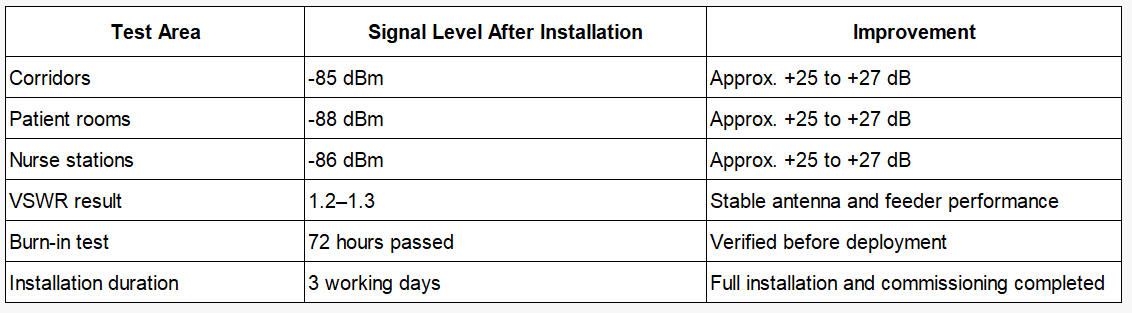
The full installation process was completed in three working days. The project included donor antenna positioning, cable routing, equipment mounting, system connection, initial tuning, and final optimization.
During commissioning, the engineering team carefully checked cable connections, antenna performance, and floor-by-floor signal consistency. The goal was not only to complete installation, but also to ensure that the final indoor coverage matched the actual building environment and communication requirements.
To verify stability, the repeater units passed 72-hour burn-in testing before deployment. After installation, engineers re-measured system performance and conducted VSWR testing, with values controlled at approximately 1.2 to 1.3, indicating that the antenna and feeder system was operating within a stable range.
Hospital technical staff also received on-site maintenance guidance so they could perform routine checks and basic maintenance after project handover.
Results After Installation
After deployment and optimization, indoor signal performance improved significantly.
Measured GSM signal levels reached approximately:
· -85 dBm in corridors
· -88 dBm in patient rooms
· -86 dBm at nurse stations
Compared with the original indoor readings of -110 dBm to -115 dBm, the final signal improvement was around 25 dB to 27 dB.
In practical terms, the hospital achieved much more stable indoor communication. Dropped calls were eliminated, and daily mobile use became far more reliable for staff and building users. The system also created a more dependable indoor communication environment for long-term building operation.
Post-Installation Results
Why This Case Matters for Healthcare Buildings
Hospitals, nursing homes, rehabilitation centers, clinics, and other healthcare buildings often face similar indoor signal challenges. These environments usually include enclosed rooms, long corridors, reinforced walls, and multiple floors that reduce signal penetration and make indoor coverage uneven.
This project shows why a custom indoor signal coverage solution is more effective than relying on a generic setup. The real value comes from understanding the building layout, measuring the donor signal, dividing the site into practical coverage zones, and tuning the system according to real operating conditions.
That is the difference between simply installing equipment and actually delivering stable, usable indoor mobile coverage.
For healthcare buildings, communication reliability matters every day. A site-based signal solution helps ensure that indoor coverage supports daily operations rather than becoming an ongoing problem.
Conclusion
This hospital signal booster project at Foshan Fifth People’s Hospital demonstrates how a properly planned GSM repeater system can solve weak indoor mobile signal in a multi-floor healthcare building.
By combining site survey, zoned system design, engineered antenna distribution, and careful tuning, Callboost delivered stable indoor GSM coverage and a more reliable communication environment for the building.
For hospitals and healthcare facilities where communication quality matters, indoor signal improvement should be based on the real building environment, not on a one-size-fits-all approach. A custom indoor coverage design is often the most practical path to dependable results.