
CB70B Quad Band Signal Booster for Practical Indoor Coverage
Poor indoor mobile signal is rarely caused by one single factor. Thick walls, low-emission glass, building structure, basement areas, distance from the base station, cable loss and poor antenna placement can all reduce indoor signal quality.
For homes, shops and small offices, the best solution is not always a high-power repeater. A compact and correctly matched [cell signal booster] is often more suitable, especially when the target area is not large but stable 2G, 3G and 4G indoor coverage is required.
Callboost CB70B is a compact [quad band booster] designed for small and medium indoor coverage applications. It supports 2G, 3G and 4G networks and is suitable for homes, apartments, retail stores, small offices, garages and light commercial spaces.
CB70B is not positioned as a large engineering repeater. Its value is simple: stable indoor signal improvement, compact size, practical functions and easier installation for small indoor projects.
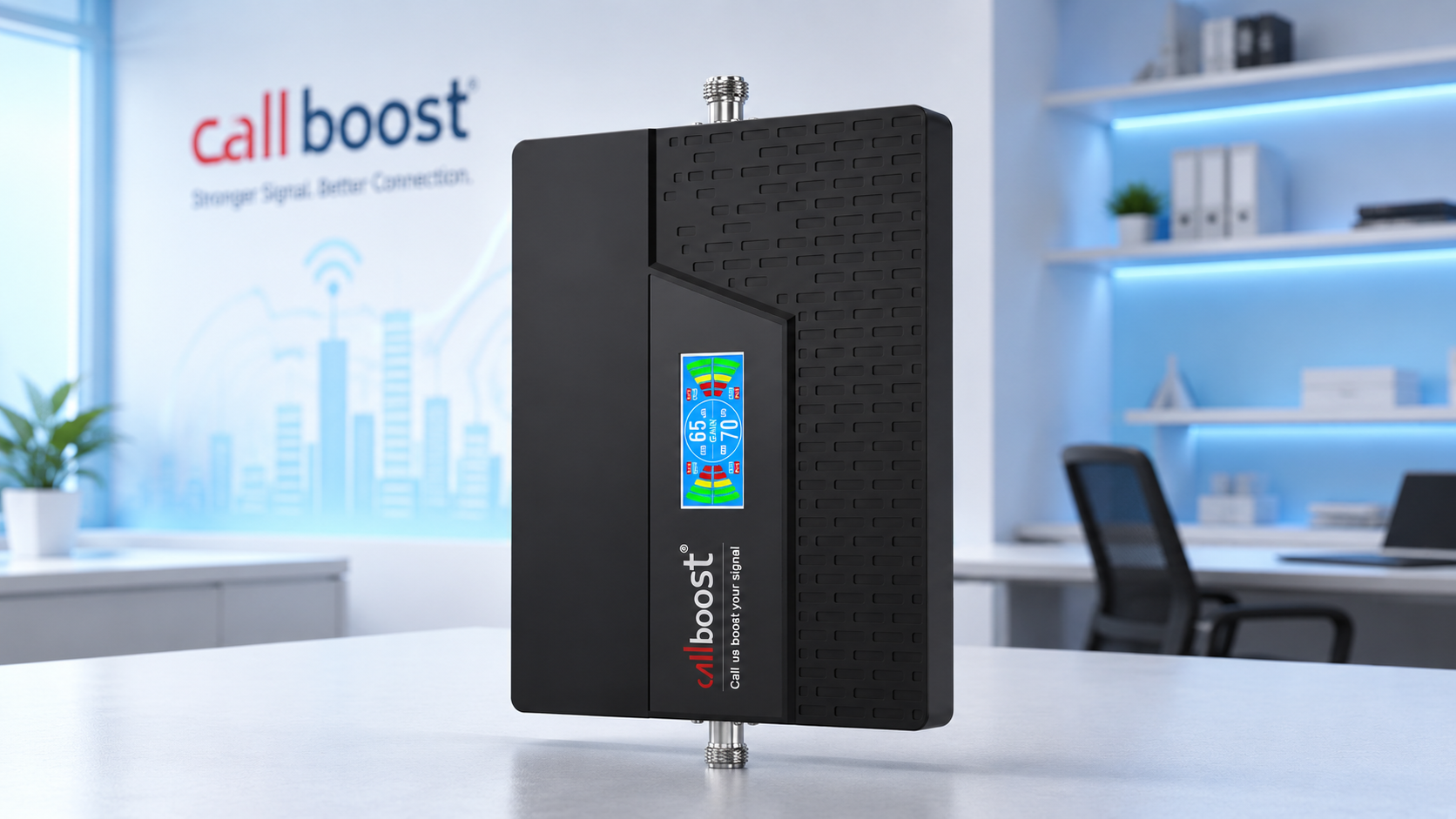
1. What Is CB70B?
CB70B is a quad band indoor mobile signal booster from Callboost. It is designed to improve weak indoor signal, unstable calls, slow mobile data and poor reception in small and medium indoor areas.
Compared with single band or dual band models, CB70B supports four frequency bands. This makes it more flexible in markets where multiple operators or network standards are used at the same time.
CB70B is suitable for:
Homes and apartments
Small offices
Retail stores and convenience shops
Small warehouses or garages
Indoor areas blocked by walls, glass or floor structures
For large shopping malls, underground parking lots, multi-floor buildings or industrial facilities, higher-power models such as CB75B, CB85B, CB90C or CB95C are usually more suitable. CB70B should be used where the project size matches its compact indoor coverage positioning.
2. Key CB70B Product Parameters
The CB70B product position can be understood through several key specifications.
| Item | CB70B Specification |
|---|---|
| Product Type | Quad band mobile signal booster |
| Supported Network | 2G / 3G / 4G |
| Gain | 70dB |
| Output Power | 20dBm |
| Product Design | Compact indoor repeater |
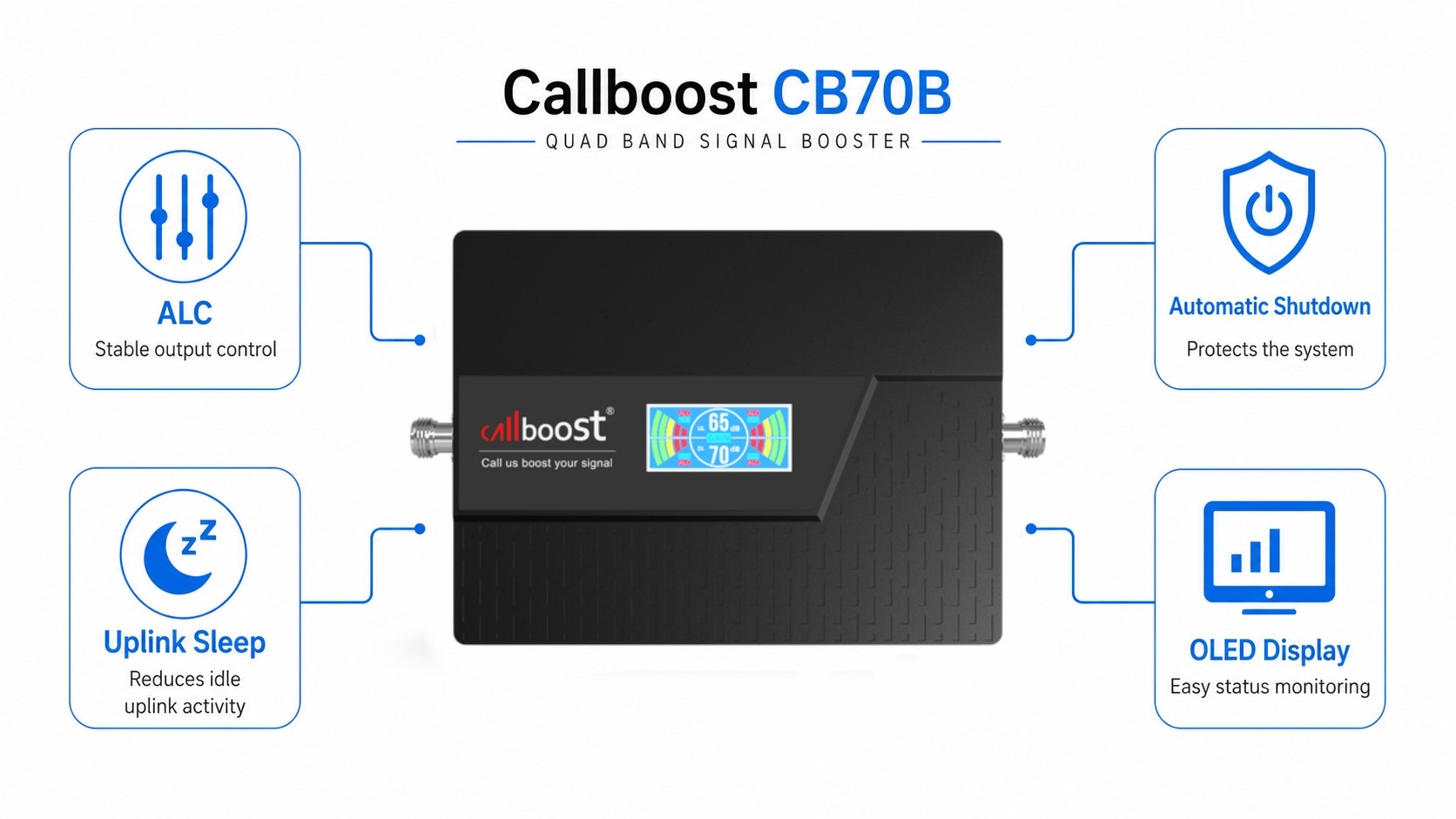
| Main Functions | ALC, automatic shutdown, uplink sleep, OLED display |
| Typical Applications | Homes, shops, small offices, small indoor coverage areas |
For a [4G signal booster], higher power is not always better. Wrong frequency selection, poor outdoor signal, insufficient antenna isolation, long cable loss and incorrect indoor antenna layout can all reduce system performance.
CB70B is designed for stable small-area indoor coverage, not for blindly pushing high output power. The final result depends on correct frequency matching, stable outdoor signal, proper donor antenna position and reasonable indoor antenna layout.
3. Why Quad Band Support Matters
Many buyers focus only on coverage area, but the first technical question should be frequency matching.
Different countries and operators use different frequency bands. Even in the same location, voice service, 4G data and different operators may use different bands. If the booster does not support the target operator frequency, it cannot improve that signal.
CB70B supports flexible quad band combinations, including common bands such as B1, B3, B7, B8, B20, B28, B2, B4 and B5 depending on market requirements.
Before choosing CB70B, the buyer should confirm:
Country and region
Target mobile operator
Working frequency bands
Outdoor signal strength
Whether the project is call-focused, data-focused or both
If the frequency band is wrong, antenna installation and repeater power become irrelevant. This is one of the most common reasons why low-quality booster projects fail.
4. ALC Control for More Stable Output
CB70B is equipped with ALC automatic level control. The purpose of ALC is to help the repeater control output level when input signal changes.
Outdoor signal is not always stable. Weather, base station load, building obstruction and donor antenna direction can all affect the signal received by the outdoor antenna. Without proper control, the booster may produce unstable output, abnormal gain or uneven indoor coverage.
ALC helps CB70B maintain a more stable output range. This is important for homes, shops and offices where the user may not have professional RF maintenance capability.
For an [indoor repeater], stable control is more valuable than simply amplifying everything. A good booster should improve usable signal while reducing unnecessary system instability.
5. Automatic Shutdown and Uplink Sleep
A mobile signal booster can create problems if installed incorrectly. Poor antenna isolation, signal overload or incorrect cable connection may cause abnormal system behavior. CB70B includes automatic shutdown and uplink sleep to improve system protection and operating efficiency.
Automatic shutdown helps protect the device when serious abnormal conditions occur. Uplink sleep helps reduce unnecessary uplink transmission when there is no active user signal.
These functions are useful for residential and small commercial users because most end users cannot perform professional RF troubleshooting. However, these functions do not replace correct installation.
If the outdoor antenna and indoor antenna are too close, if the cable is poor quality, or if the donor antenna points in the wrong direction, the system may still perform badly. Protection functions reduce risk, but they cannot fix a bad RF design.
6. OLED Display for Easier Status Checking
CB70B uses an OLED display to show device status more clearly. This helps users and installers check whether the booster is working normally.
Many low-cost boosters give users very little information. When the signal does not improve, users can only move antennas, restart the device or replace cables without knowing the actual problem.
OLED display makes the system more transparent. It can reduce blind troubleshooting and make installation checks easier for dealers, installers and end users.
The display is not a replacement for professional planning. The correct process is still to test outdoor signal first, confirm frequency bands, choose a proper antenna location and then install the booster system.
7. Die-Cast Aluminum Housing for Heat Dissipation
Signal boosters are communication devices that may operate for long periods. Heat dissipation affects long-term stability.
CB70B uses a die-cast aluminum housing, which helps improve heat dissipation and mechanical durability. For a compact repeater, this is more important than appearance. A device installed in a hot, sealed or poorly ventilated position may become less stable over time.
CB70B should be installed in a dry and ventilated indoor location. It should not be placed inside a sealed box, near high-temperature equipment or in a wet environment.
8. How a CB70B System Should Be Installed
A typical CB70B system includes:
Outdoor donor antenna
CB70B repeater
Coaxial cable
Indoor coverage antenna
Splitter or RF accessories when required
The correct installation logic is simple. First, find a usable outdoor signal source. Then install the donor antenna in the best direction. Next, connect the antenna to the CB70B repeater through coaxial cable. Finally, use the indoor antenna to distribute signal to the target area.
The most common mistake is installing the booster without testing outdoor signal. If there is no usable outdoor signal, no [signal booster] can create mobile network coverage from nothing.
The second common mistake is insufficient antenna isolation. If the outdoor donor antenna and indoor antenna are too close, the system may self-oscillate. This can cause reduced gain, alarm status or automatic shutdown.
The third common mistake is excessive cable loss. Long or low-quality cable can reduce the actual system gain. For a compact indoor booster such as CB70B, cable length and cable quality should be controlled carefully.
9. Who Should Choose CB70B?
CB70B is suitable for users who need practical indoor signal improvement without using an oversized engineering repeater.
It is a good fit for residential users who have weak indoor signal but still receive usable signal outdoors. It is also suitable for small shops where poor mobile reception may affect calls, customer communication or mobile payment.
Small offices can also use CB70B when employees experience unstable calls or weak mobile data in specific indoor areas.
For distributors and installers, CB70B can be positioned as a compact quad band solution for small and medium indoor projects. It offers a balance between frequency flexibility, practical control functions and installation simplicity.
CB70B should not be presented as a universal solution. If the project requires coverage for a large factory, multi-floor commercial building or underground parking area, a higher-power engineering model should be selected.
Conclusion: CB70B Is a Compact and Practical Quad Band Booster
CB70B is not designed to replace large engineering repeaters. It is a compact quad band indoor signal booster for homes, shops, small offices and small commercial spaces.
Its value comes from the combination of 70dB gain, 20dBm output power, quad band support, ALC control, automatic shutdown, uplink sleep, OLED display and die-cast aluminum housing.
For customers who need stable indoor signal improvement, the key is not choosing the highest power model. The real key is correct frequency matching, usable outdoor signal, proper antenna isolation, good cable quality and reasonable indoor antenna layout.
If you are looking for a compact [CB70B signal booster] for home, shop or small office coverage, Callboost can help recommend a suitable configuration based on your country, operator frequency bands, building structure and target coverage area.