
A mobile signal booster project is not only about buying a repeater with high gain or a large coverage claim. In real installations, many projects fail because the system is selected without proper RF engineering logic.
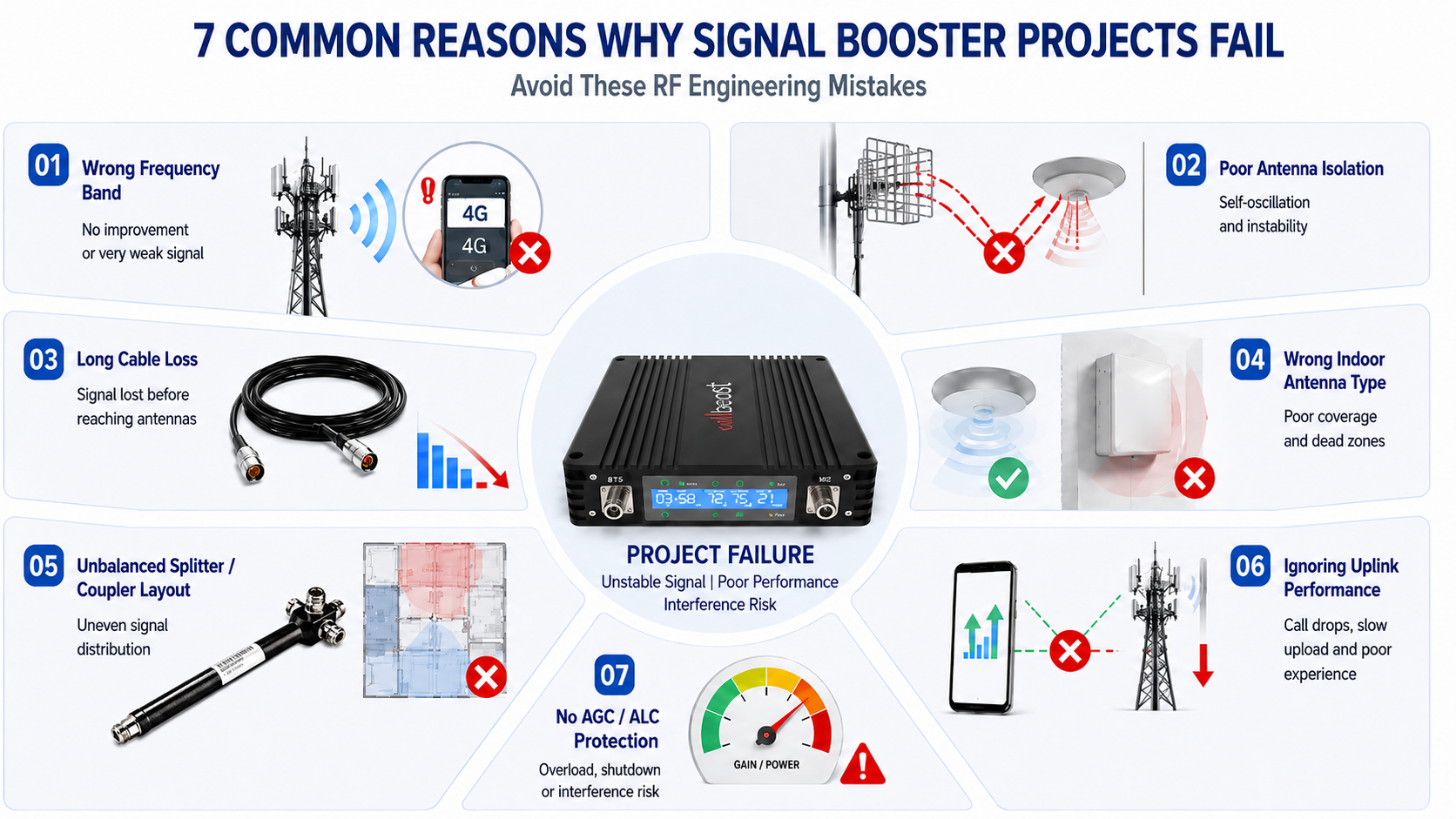
A stable booster system must consider outdoor signal strength, frequency band, antenna isolation, cable loss, indoor antenna layout, output power, uplink performance and automatic protection functions. If these factors are ignored, the result may be unstable signal, poor call quality, weak data speed, self-oscillation or interference with the operator’s network.
Below are seven common mistakes buyers should avoid before choosing a 4G or 5G mobile signal booster solution.
1. Choosing a Booster Only by Coverage Area
Many buyers only ask: “How many square meters can this booster cover?”
This is the wrong starting point.[It usually depends on many factors].
Coverage area depends on outdoor signal strength, building structure, cable length, antenna quantity, indoor layout and frequency band. A 75dB booster may work well for a medium indoor project when the outdoor signal is usable and the antenna layout is correct. But the same model may perform poorly in a basement, warehouse or thick concrete building if the system design is wrong.
For example, Callboost 75dB series boosters are commonly used for medium indoor coverage projects around 500–1000㎡, depending on real installation conditions. For larger projects, Callboost also provides 85dB, 90dB and 95dB engineering-level repeaters.
The better question is not only “How large can it cover?” but “What signal source, frequency band and antenna design does this project require?”
2. Ignoring Frequency Band Confirmation
A mobile signal booster must match the local operator’s frequency band. If the booster does not support the correct band, it will not solve the problem, even if it has high gain or high output power.
This is one of the most common buyer mistakes.
Different countries and operators use different LTE and 5G bands. Even in the same country, one operator may use different bands for 2G, 3G, 4G and 5G services. Before choosing a booster, buyers should confirm the country, city, operator, required network type and outdoor signal condition.
Callboost boosters can support single-band, dual-band, triple-band, four-band and five-band options depending on the project requirement. For engineering projects, band confirmation should always come before model selection.
3. Focusing Only on Downlink and Forgetting Uplink
Many buyers care only about stronger signal bars on the phone. This usually means they are only looking at downlink performance.
[But mobile communication is two-way.]
Downlink is the signal from the base station to the mobile phone. Uplink is the signal from the phone back to the base station. If downlink improves but uplink remains weak, the phone may show better signal bars, but calls can still drop and mobile data may remain unstable.
Professional signal booster design must balance uplink and downlink gain. Callboost boosters include uplink sleep function. When there is no user activity in the coverage area, the device can reduce unnecessary uplink activity and help lower interference to the base station.
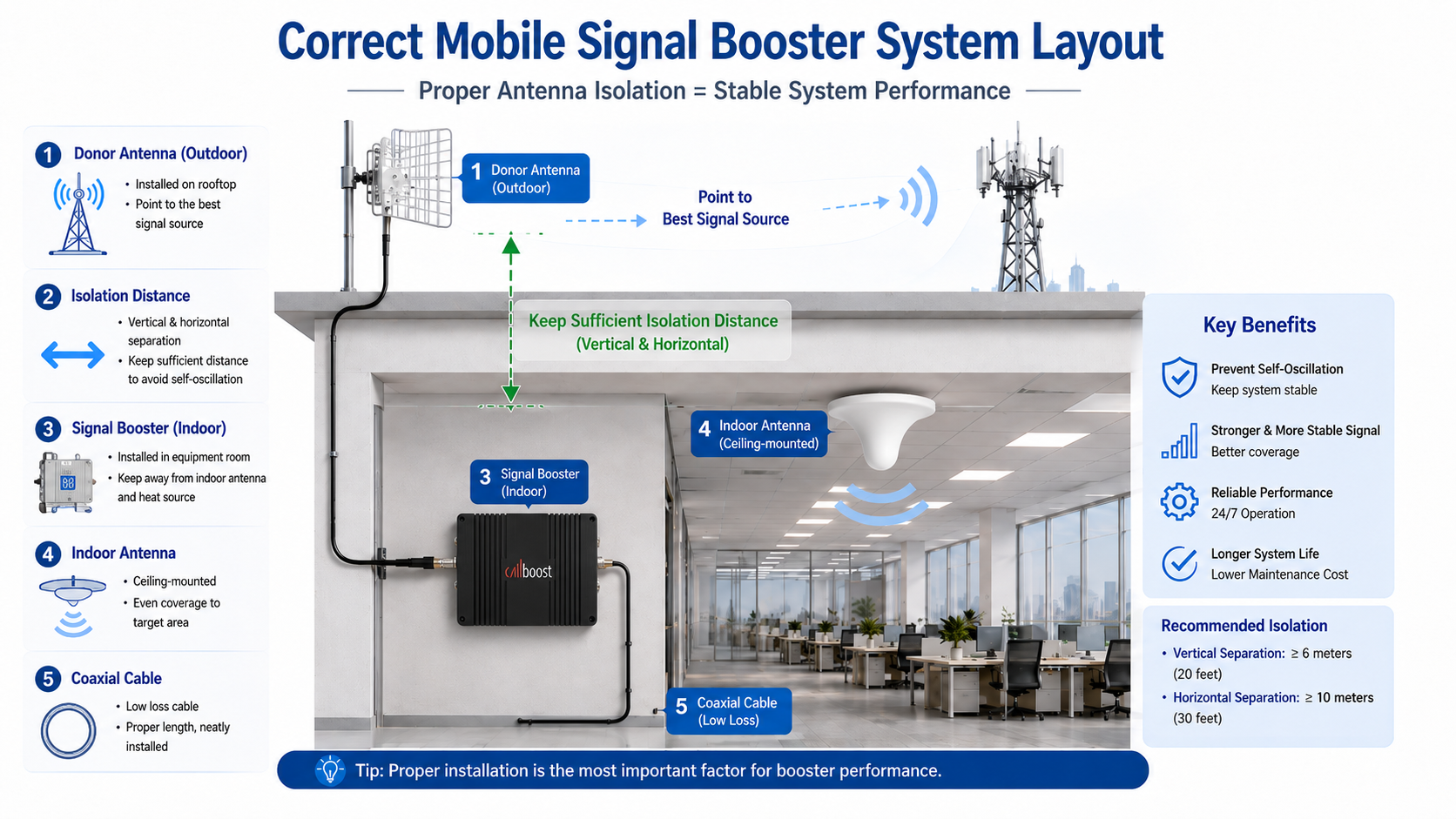
4. Poor Antenna Isolation Causing Self-Oscillation
Self-oscillation is one of the most serious problems in booster installations.
It happens when the indoor antenna signal leaks back to the outdoor donor antenna and creates a feedback loop. This is similar to a microphone placed too close to a speaker. In RF systems, it can cause unstable output, poor signal quality, system shutdown or network interference.
Common causes include short distance between outdoor and indoor antennas, wrong antenna direction, weak wall separation, excessive gain setting and incorrect antenna position.
Callboost boosters include real-time isolation detection and self-excitation elimination. When isolation is not enough, the device can detect the condition and automatically reduce gain. If severe self-oscillation or overload occurs, the booster can shut down output to protect the equipment and reduce interference risk.
5. Using the Wrong Indoor Antenna Type
Indoor antenna selection directly affects coverage quality.
A ceiling antenna and a wall-mounted panel antenna are not the same product. A ceiling antenna is installed on the ceiling and is suitable for open indoor areas such as offices, shops, hotel floors and residential spaces. A wall-mounted panel antenna provides directional coverage and is more suitable for corridors, underground parking areas, warehouses and basements.
Using the wrong antenna can create coverage holes, wasted power or unstable indoor signal.
A professional project should not simply use more antennas. It should use the correct antenna type in the correct position.
6. Ignoring Cable Loss, Splitters and Couplers
In a real booster system, the repeater is only one part of the solution. [Cables and passive components also affect final performance].
Long coaxial cables create signal loss. Power splitters divide signal to multiple antennas. Directional couplers distribute signal unequally for different coverage zones. If these components are selected incorrectly, some areas may receive too much signal while others remain weak.
Callboost solutions can include repeater devices, outdoor donor antennas, indoor ceiling antennas, wall-mounted panel antennas, coaxial cables, RF connectors, power splitters, directional couplers and lightning protectors. The purpose is not only to provide equipment, but to build a balanced RF distribution system.
7. Selecting a Booster Without AGC, ALC and MGC
A basic amplifier may boost signal, but it may not control signal properly.
Outdoor signal strength changes during the day. Network load changes. User activity changes. If the booster cannot adjust output automatically, it may become overloaded, unstable or noisy.
Important control functions include:
AGC: automatically adjusts gain to prevent overload.
ALC: keeps output power stable.
MGC: allows manual gain adjustment during installation.
Automatic shutdown: protects the system during severe overload or oscillation.
Uplink sleep mode: reduces unnecessary uplink interference when no users are active.
Many [Callboost models] support MGC with 1dB step adjustment within a 31dB range, together with ALC, isolation detection and automatic shutdown functions.
When Should Buyers Choose Higher-Level Booster Models?
Not every project needs a high-power booster. The correct model depends on real project data.
As a general reference:
75dB boosters: medium indoor coverage projects
85dB boosters: larger buildings, shops, warehouses and commercial spaces
90dB repeaters: large engineering coverage, factories, basements and wider indoor systems
95dB repeaters: high-power engineering projects and large-area coverage
For example, Callboost CB90C series can provide 90dB gain and 37dBm downlink output power. Callboost CB95C series can provide 95dB gain and up to 43dBm downlink output power for more demanding applications.
However, higher power is not always better. If antenna isolation is poor or frequency selection is wrong, a high-power booster can make the problem worse.
What Information Should Buyers Provide?
Before choosing a booster, buyers should provide:
Country and city
Mobile operator
Required network: 2G, 3G, 4G, 5G or mixed
Outdoor signal strength
Frequency band information
Building size and floor quantity
Indoor weak-signal areas
Photos of outdoor antenna position
Cable route and equipment room location
Without this information, any recommendation is only a guess.
Final Thoughts
Most mobile signal booster projects do not fail because boosters are useless. They fail because the system was not designed correctly.
The most common mistakes are choosing by coverage area only, ignoring frequency bands, focusing only on downlink, poor antenna isolation, wrong indoor antenna selection, ignoring cable loss and using devices without proper control functions.
A professional signal booster system must be designed as a complete RF solution. The repeater, donor antenna, indoor antennas, cables, splitters, couplers and protection functions must work together.
Callboost provides 4G and 5G mobile signal booster solutions for homes, offices, hotels, warehouses, commercial buildings, underground parking areas, rural projects and engineering applications. If you are not sure which booster is suitable for your project, contact Callboost with your country, operator, building size and signal condition.