
At MWC26 in Barcelona, Huawei introduced a new wave of 5G-A technologies, including the 256-channel U6GHz Active Antenna Unit, bringing outdoor mobile network capability closer to the 10 Gbps era. For the telecom industry, this is a clear sign that base station performance is moving to a much higher level.
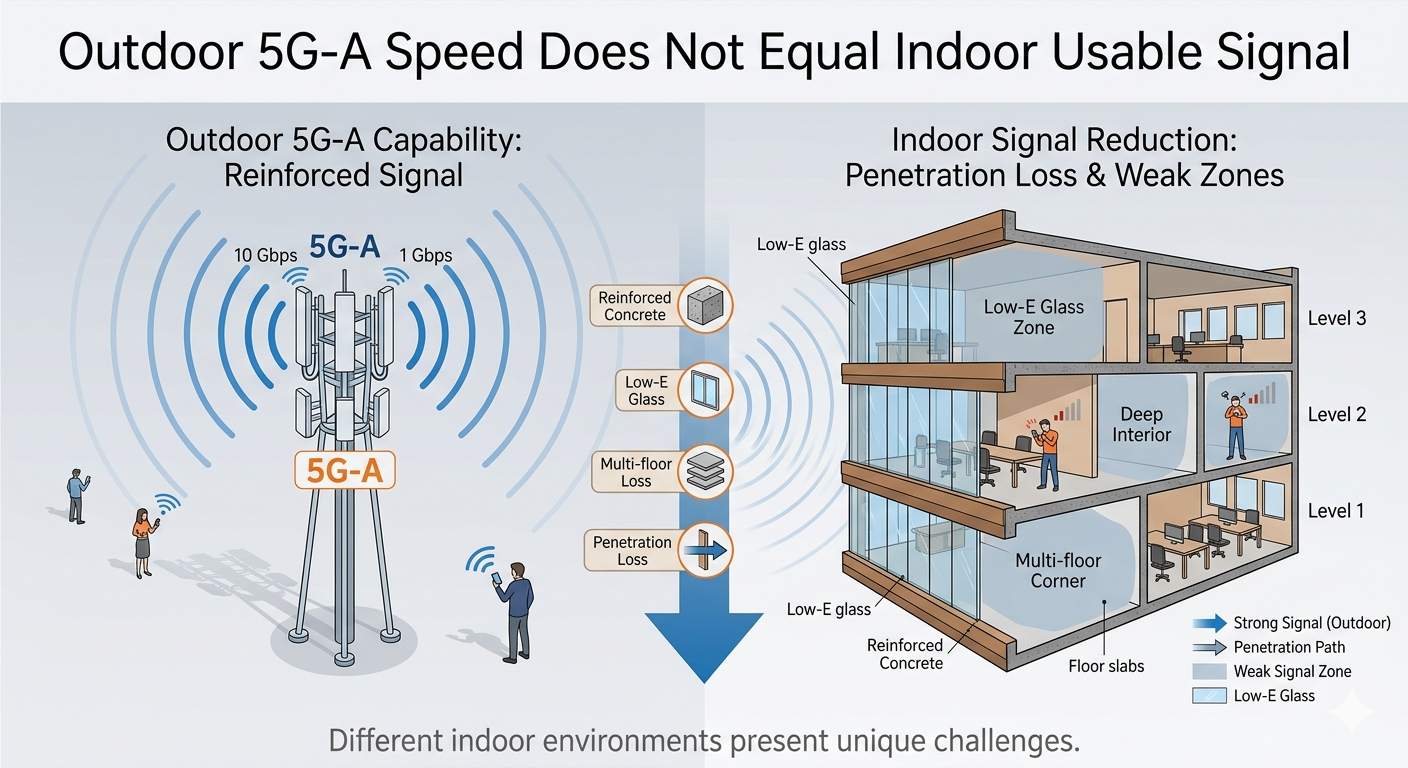
But for real buildings, the most important question is not just how fast the outdoor network can become. The real question is whether that signal can still remain stable and usable after passing through walls, Low-E glass, reinforced concrete, multiple floors, and other complex building structures.
That is why indoor mobile signal coverage still matters. Even when outdoor networks continue to improve, offices, hotels, warehouses, villas, hospitals, shopping centers, and underground garages can still suffer from weak indoor signal. Stronger outdoor network capability does not automatically become stronger indoor usable coverage.
Part 1: What Does 5G-A Actually Change?
5G-A, also referred to as 5.5G, is considered the next major step between 5G and 6G. Compared with previous network generations, it pushes mobile communications toward several higher-performance targets:
Peak downlink speed: 10 Gbps
Peak uplink speed: 1 Gbps
Connection density: millions of devices per square kilometer
Latency: millisecond-level response
In practical terms, this means faster downloads, smoother 8K or VR content delivery, more stable real-time applications, and greater support for large-scale connected devices.
From the base station side, this is a major breakthrough.
Band Comparison Table
| Band Type | Representative Frequency | Penetration Capability | Speed Capability |
|---|---|---|---|
| Low Band | 700-900 MHz | Strong | Moderate |
| Mid Band | 1.8-2.6 GHz | Moderate | Good |
| 5G Mid-High Band | 3.5-4.9 GHz | Weak | Excellent |
| 5G-A New Band | U6GHz (6.4-7.1 GHz) | Very Weak | 10 Gbps |
No matter how advanced the base station becomes, signal propagation still follows the laws of physics. Higher frequencies provide higher speed and bandwidth, but their ability to penetrate walls, glass, and reinforced concrete is much weaker than traditional low-band signal.
That is why faster outdoor networks do not automatically solve indoor weak-signal problems.
Part 2:Why Indoor Signal Still Fails in Modern Buildings
Modern buildings are more energy-efficient, more enclosed, and more structurally complex than ever before. Ironically, those same features often make indoor mobile signal worse.
Once signal tries to enter a real building, it has to pass through walls, glass, metal insulation, and multiple floors. In many cases, those materials weaken, reflect, or block signal before it reaches the user.
Building Material Impact Table
| Building Material | Purpose | Impact on Signals |
|---|---|---|
| Reinforced Concrete | Structural support | Natural shield; signal attenuation of 20-30 dB |
| Low-E Glass | Energy efficiency | Metal oxide coating blocks signal entry |
| Metal Insulation Layers | Building energy conservation | Fully reflects radio waves, creating dead zones |
| Underground Garages | Space utilization | Completely isolated; base station signals cannot penetrate |
This is why many buildings still suffer from dropped calls, unstable data, and weak signal in enclosed or internal areas even when outdoor service seems acceptable.
It is also why adding more outdoor base stations does not completely solve indoor coverage in every scenario. In many projects, the outdoor network improves first, while indoor mobile usability still lags behind.
Part 3: Callboost’s “Last Meter” Solution
The 256-channel U6GHz AAU highlighted at MWC26 answers one question very well: how strong outdoor base station capability can become.
But indoor communication is a different problem.
Once a signal enters a real building, it faces a completely different propagation environment. That is where Callboost’s role begins.
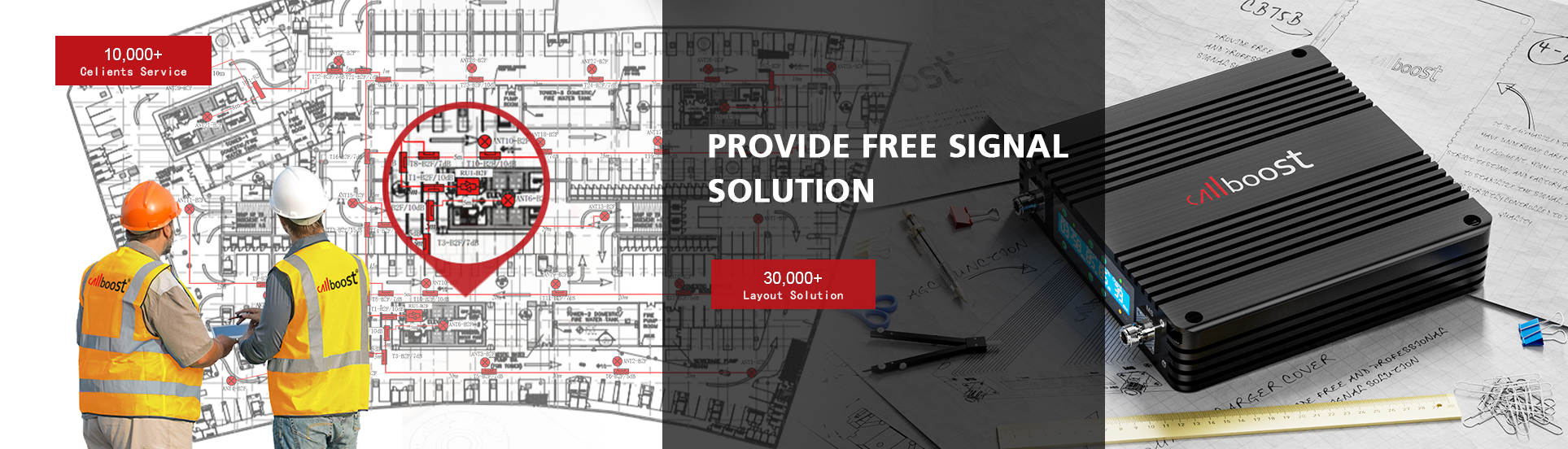
Callboost does not build base stations or develop 5G-A core chips. We focus on bringing available outdoor carrier signal indoors and turning it into stable, usable mobile coverage for real buildings and project sites.
Zero-Interference Commitment for 5G Networks
High-power 5G boosters can interfere with base stations if not properly controlled. Callboost’s 5G-A compatible repeaters feature Industrial-grade ALC (Automatic Level Control) and ISO (Isolation Detection). These smart sensors automatically balance uplink and downlink gain, ensuring 100% compliance with local carrier standards and zero base station interference.
How Does Callboost Work?
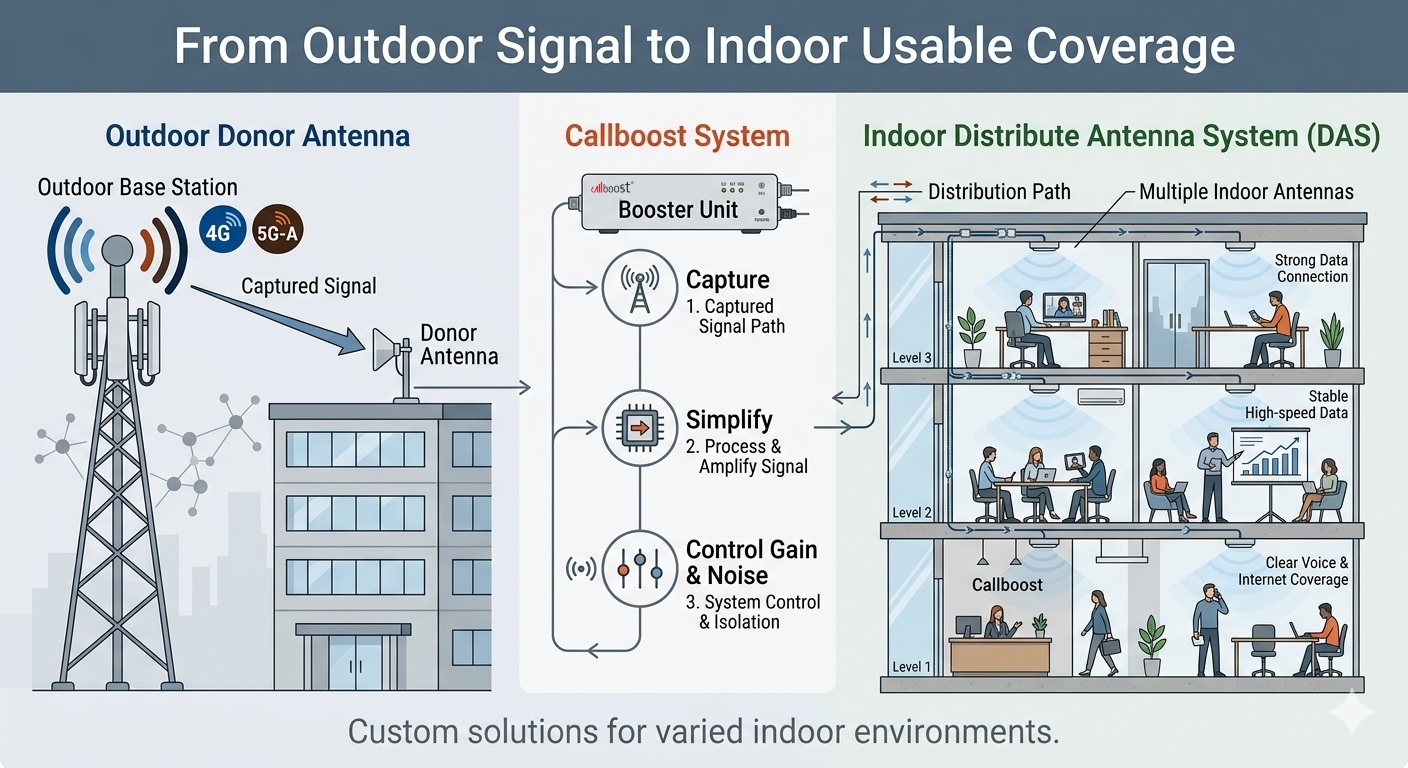
A Callboost solution usually works in three steps:
Capture — the outdoor donor antenna captures available signal from the base station
Amplify — the booster unit strengthens the signal while controlling gain and interference
Distribute — indoor antennas rebroadcast the improved signal into the required indoor space
The principle itself is straightforward, but stable indoor coverage depends on proper engineering design, correct equipment selection, and site-based installation.
Technical Feature Table
| Technical Feature | Purpose | Callboost’s Approach |
|---|---|---|
| Multi-Band Support | Different carriers and regions use different frequency bands | Dual-band, quad-band, and customizable configurations |
| Automatic Gain Control (AGC) | Prevents excessive signal from interfering with base stations | Built-in smart AGC that adjusts output power in real time |
| Oscillation Protection | Prevents feedback when indoor and outdoor antennas are too close | Automatic shutdown upon oscillation detection to protect equipment |
| Industrial-Grade Components | Reliable operation in harsh environments like vehicles or outdoor settings | Industrial-grade electronic components with aluminum alloy casing for heat dissipation |
Callboost focuses on mobile signal coverage, not Wi-Fi extenders or router boosting solutions. Our work is centered on turning outdoor network potential into real indoor mobile usability.
Part 4: Real-World Signal Challenges
Indoor weak-signal problems are not abstract theory. They appear repeatedly in real projects.
In one rural project scenario, users found that even after local network upgrades, indoor signal was still too weak for stable daily communication. The issue was not a complete lack of service outdoors, but poor indoor penetration caused by terrain and distance from the source station.
In a warehouse project, the signal near the entrance remained around 2–3 bars, but deeper inside the building it dropped to 1 bar, with 5G often falling back to 4G. The steel structure clearly weakened the signal as users moved further indoors.
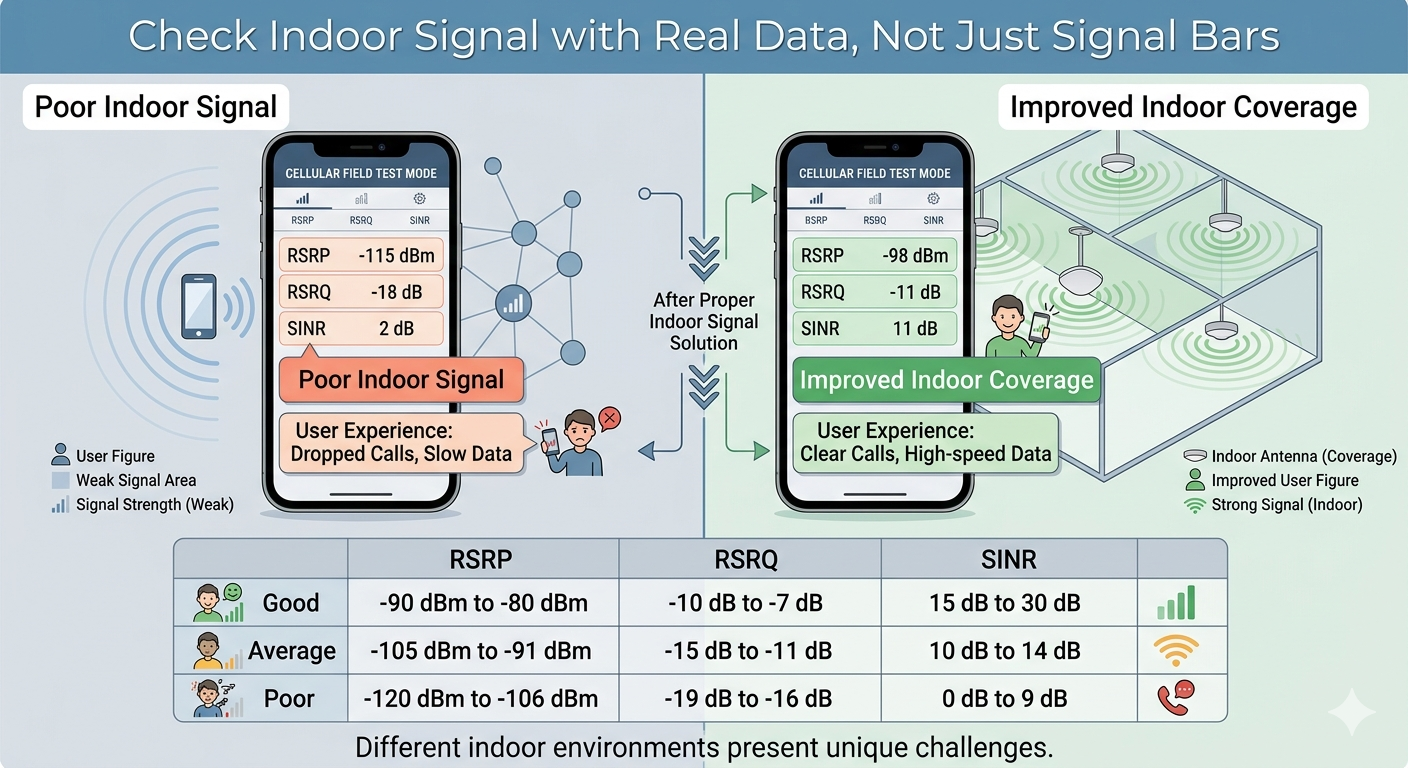
In another indoor case involving Low-E glass, Field Test Mode showed RSRP around -95 dBm near the window, but only -115 dBm in the center of the room. After adding an outdoor antenna and an indoor booster solution, signal improved to around -98 dBm, allowing more stable calling and data usage.
These examples all show the same pattern: the outdoor network may exist, but the building itself becomes the barrier.
Part 5: Let Data Speak—How to Check Indoor Signal Quality
For building owners and project managers, signal bars are not enough. Real indoor signal should be checked with measurable data.
On iPhone, this can be done by entering Field Test Mode. On Android, tools such as Network Cell Info Lite can help users check signal conditions more clearly.
Understanding Key Metrics
| Metric | Good | Average | Poor | Very Poor |
|---|---|---|---|---|
| RSRP (Signal Strength) | > -89 dBm | -90 to -99 dBm | -100 to -109 dBm | < -110 dBm |
| RSRQ (Signal Quality) | > -10 dB | -11 to -15 dB | -16 to -20 dB | < -21 dB |
| SINR (Signal-to-Noise) | 13-20 dB | 7-13 dB | 0-7 dB | Below 0 dB |
A proper indoor coverage solution can often improve RSRP by around 10–20 dB under suitable site conditions. In practical terms, that can be the difference between unstable signal and usable daily communication.
Signal should not be checked only at the entrance or near a window. The real evaluation should follow the actual building layout and the places where people work, stay, and move.
Part 6: Why Customized Engineering Solutions Matter
Not all buildings need the same solution.
A warehouse, hotel, office tower, villa, shopping center, hospital, and underground garage do not share the same layout, attenuation pattern, user density, or installation logic. That is why one-size-fits-all signal enhancement often fails in real projects.
Callboost focuses on project-based indoor mobile signal coverage solutions, including:
frequency confirmation
weak-zone identification
building layout analysis
system design
equipment matching
antenna deployment planning
installation guidance
technical support after deployment
For customers who need a practical and maintainable solution, engineering design matters just as much as the hardware itself.
Conclusion
5G-A is clearly raising the ceiling for outdoor mobile network performance. Technologies such as the 256-channel U6GHz AAU, ELAA, and gigabit-level user experience show how quickly the network side is evolving.
But stronger outdoor capability does not remove the need for professional indoor signal coverage.
As long as real buildings continue to use reinforced concrete, Low-E glass, steel structures, underground layouts, and other signal-blocking materials, indoor mobile usability will remain a practical engineering challenge.
Whether it’s N78 (3.5GHz) for urban centers or specialized industrial bands, our systems are designed to handle high-frequency 5G attenuation.
That is why indoor signal coverage still matters in the 5G-A era. And that is why Callboost continues to focus on turning available outdoor carrier signal into stable, usable indoor mobile coverage for real buildings and project environments.